
Showing posts with label dogs. Show all posts


Roughly two-thirds of US families have one or more dogs. Most allow their dogs in the house, but there are some families who keep their dogs outdoors. But even families who have their dogs living in the home need to leave them outdoors from time to time. Sometimes that ends up being the wrong time, and the dog gets caught outdoors in bad weather.

Granted, some dogs love the outdoors and their coats help keep them warm when the weather starts getting chilly. Even so, sometimes the temperature drops faster than we expect, leaving our furry friends and guardians stranded and cold. It would be nice for them to have some place to go into, just to keep warm.

There are a few basic things to do, as part of making a good winter doghouse which will keep your friend warm, those times when they have to be outdoors and need a safe refuge.

  • Insulate it – Most doghouses are a simple wood wall, without any insulation. Even adding one inch of Styrofoam insulation can do wonders in keeping your dog warm. We’re going to add two layers of ¾” thick insulation, giving a total R-value of 7.5. That’s not as good as a house, but a whole lot better than windows and doors.
  • Put in an insulated floor – Getting ‘Fido’ up off the ground can make a huge difference, as the ground is often colder than the ambient air. Since you’re going to put in a floor anyway, why not insulate that floor.
  • Make two rooms – This is the one hardly anyone thinks about. If you make a two-room doghouse, with a entry room and a bedroom, arranged so that the doorway to the bedroom is 90 degrees to the entry door, your dog will be a whole lot warmer. Any wind coming in the front door won’t be able to just go directly into their sleeping room.
  • Make a hinged roof – When your pet is in their home, comfy and warm, they might not be all that willing to come out. Making the roof hinged, so that you can lift it up, makes it possible for you to get to your dog, even if they’re not in a hurry to come out. Of course, if that doghouse is kept on the back porch, instead of out in the yard, you can use a flat roof, which is a whole lot easier to hinge.

The Start (The Foundation)

Just like building a home, you need to start your dog’s house by building a frame. The siding and insulation will be added to that later. But just how big should you build it? That depends on the size of your dog.

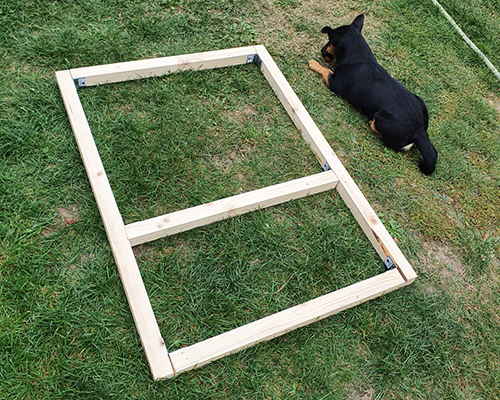
All you need to do is measure your dog’s length and standing height to figure out the dimensions. The bedroom should be roughly square, with each wall being roughly the length of your dog, lying down, as shown in the photo below. Keep in mind that you’re going to be adding a ½” thick layer of OSB (oriented strand board) to the inside of the walls, so make your framework slightly larger than that. The height of the doghouse needs to be at least four inches higher than the doorway.

The entry room only needs to be wide enough for the dog to get in, more like a hallway than an actual room. Keep in mind though, that if it is too narrow, the dog may spook and not go in. Making it roughly half the width of the bedroom works out well.
Easy DIY Winter Doghouse

To make the frame, use 2”x 2” dimensional lumber. The basic idea is a box, with a patrician to divide it into the two rooms. So start out by making the outline of the floor, using the dimension you measured for your door laying down, plus one inch, for the bedroom, and the width you need for the door for the other room. You’ll actually need three identical pieces, one for the bottom, one for the top and one for the lid.

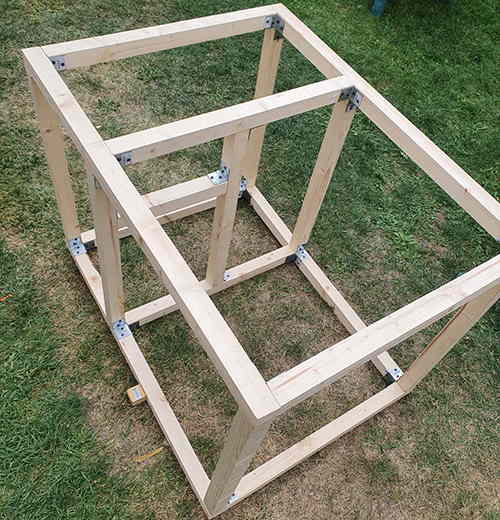
The easiest way to connect the pieces together is to use metal angle brackets on the inside of the corners, as you can see in the photo below. it really doesn’t work well to glue and nail the pieces together, because end-grain doesn’t glue well, and all the joints have at least one piece which is end-grain. Screws don’t work well either, as the screw threads tear up the grain, eventually causing the joint to fail. Using inexpensive metal angle brackets provides the strongest connection, helping your pet’s house to last longer.

Once the top and bottom are put together, you’re going to need to cut six identical pieces of 2”x 2” to make the vertical parts of the frame. These will go in the four corners, as well as at both ends of the dividing wall. The dividing wall also needs to have the doorway framed in. That means adding in one additional vertical element, along with a horizontal beam across the top of the door frame. As you can see in the picture below, there are several inches of space above the doorway.
Easy DIY Winter Doghouse

The Flooring And Insulation For Winter

With the frame in place, it’s time to put in the flooring and insulation. Start by cutting a piece of OSB large enough to cover the entire bottom of the frame, all the way to the edges. This can be attached to the bottom with glue and nails or screws. Make sure the corners all match up, as this piece is going to keep the corners of the doghouse square.

With that piece in place, flip the doghouse over, so that it is on the bottom. Then cut and place either fiberglass batts or Styrofoam sheets to fit inside the floor. Then cover them with a layer of OSB, notched to fit between the vertical structural elements.
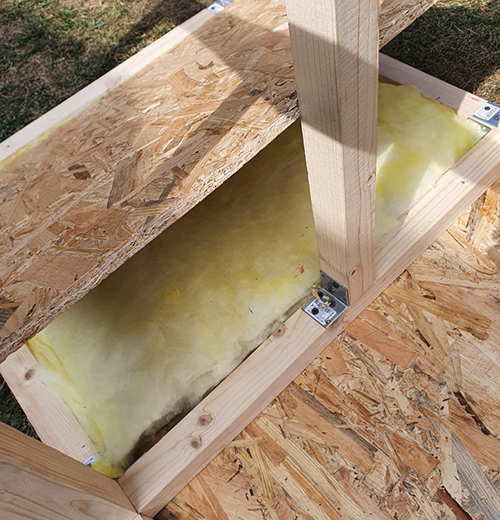
Easy DIY Winter Doghouse

The Walls Of The Doghouse

With the floor in place, the interior walls can be added. Notice in the photo below, that the piece of OSB being used for the wall is notched to go around the horizontal structural elements. It only goes halfway across the vertical elements, leaving wood for the other panel to attach to as well.
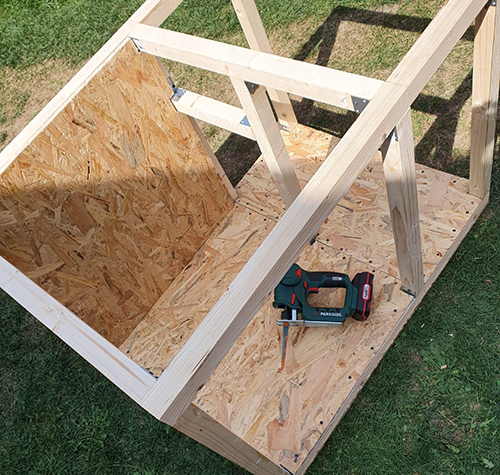
Easy DIY Winter Doghouse

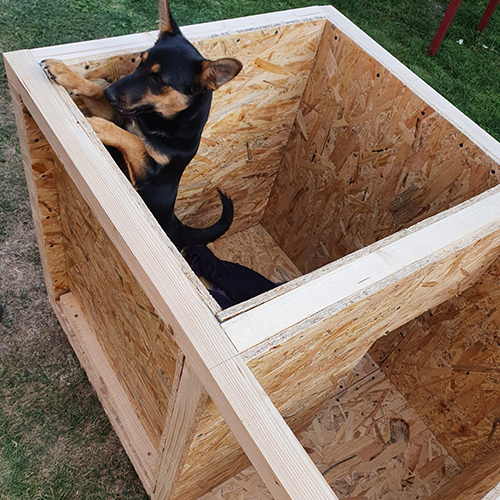
Continue adding the OSB to the inside of the dog house, finishing off all the walls. If you look at the picture below, you’ll see a 2”x 2” block nailed above the flooring, on the left side of the picture (the wall the dog is leaning against). That was added, because there was nowhere to attach that interior wall, as the floor covered the frame element there. You will need to add such blocks all the way around the base,with the exception of the doorway.

Another important thing to notice from this photo is that only the end piece (next to the dog) is attached to the vertical corner brace. The wall that the dog is leaning against is not. This is not a problem. As the OSB panel is attached at the top and bottom. The doghouse doesn’t need the full structural strength of a home. It’s not as if the dog is going to push this wall down or hang a heavy mirror on it. As long as the board is stable, it is sufficient.Easy DIY Winter Doghouse
With the interior walls in place, it’s time to install the insulation and put the siding on the house. The same fiberglass batts or Styrofoam sheets that was used in the floor can be used in the exterior walls. Glue or staple them in place, so that they are not a problem as the siding is installed.

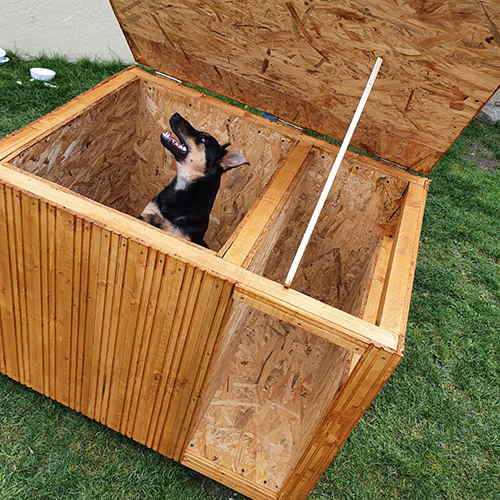
There are several options to choose from for the exterior siding. In this case, we chose to use some beaded planking we had sitting around, which would normally be a rather expensive option for a doghouse. But it was leftover from a project, so it was ideal. A less expensive option would be to use T-111 siding, probably the least expensive siding on the market.
Easy DIY Winter Doghouse

The only other thing that’s left is the top. This is where the third frame comes in. It is built essentially the same way as the rest of the doghouse, starting by attaching a piece of OSB to the inside, squaring up the frame. Make sure that it matches up with the doghouse itself, before putting in all the fasteners. Then add the insulation and finally the siding for the exterior of the top.

The top is best attached to the doghouse with hinges, allowing it to be lifted to get to the dog inside and to clean the doghouse, if necessary. a handle can be added at the front, making it easier to lift the lid. We didn’t bother, but a prop rod could be installed permanently, although that might end up being a problem, if it falls down and scares the dog.

Your finished doghouse is best sitting in the corner of the patio, where it has some protection from the weather. That will help keep it from getting cold inside, as well as protecting the wood from damage.
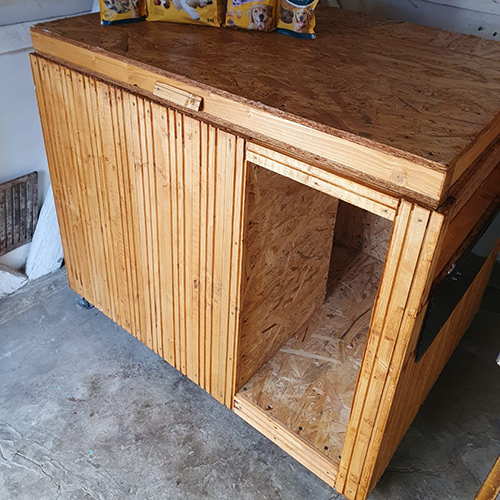
Easy DIY Winter Doghouse

It’s important to have a doghouse, even if your dog lives in the house with you. If you’re going to build a doghouse, why not make it one that’s insulated against the cold, so that your family friend can really get out of the cold and be relatively warm while they wait for you. If it’s done right, the dog’s own body heat will warm the doghouse, once they get inside. Got any suggestions leave em in the comments below 


Living in a homestead without a dog, is like living in a house with no electricity. It just doesn’t feel right. Homesteads are renowned for having a four legged buddy around for security, hunting, or herding purposes.

I can boldly attest to the popular line that says “a dog is a man’s best friend.” Truly it is – running a homestead is a labor intensive endeavor, and having a dog around can make your life so much easier.

There are many different types of dog breeds you can choose from, however be warned: choosing the right type of breed is as critical as choosing your life partner.

Some dog breeds are so beautiful on the outside whilst they can be so aggressive on the inside. They might spread their love to you “the owner” but rack havoc upon your most delicate farm animals, such as poultry and young livestock, so choose wisely!

How To Choose The Right Dog Breed For Your Homestead

Just to get this clear from the get-go: there is no right or wrong dog breed, though there are ones that are more right than others to have around in your homestead. This is about what you want and what your needs are. Also please note that the dog breeds mentioned in the article are selected from my point of view; opinion based from my experience with dogs and from my homestead.

The first thing to consider when choosing a dog breed is this:

The Purpose Of The Dog

Are you looking for a dog to:

  • Help you hunt.
  • Protect your livestock against wild animals.
  • Alert you of unwanted guests.
  • Or just to be a companion.

The Question is: Why?

Whatever the reason, note it down and go to the second consideration, which is:

The Type Of Farm Animals You Have

Which type of farm animals currently reside on your property?

Chickens? Sheep? Cows? Or you don’t have any?

Some dogs are said to have a high prey drive which is the tendency of a dog to want to chase, fight, grab, play with, or mistakenly or purposefully kill your small animals.

Examples of these types of dogs are: Boston Terriers, Australian Cattle Dogs and Whippets. Try to avoid these if you do have small or delicate animals, such as poultry and rabbits.

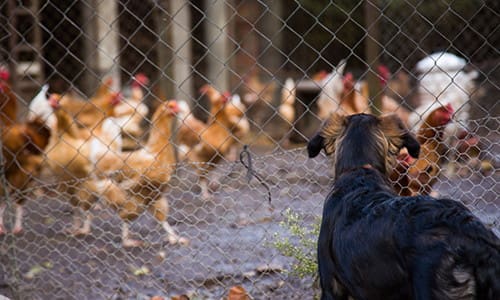
dog watching poultry

Best Dog Breed For Hunting

Hunting dogs often have a high prey drive, so choosing one to accompany you at your homestead is a tricky equation. From my experience and biasness, I have only one that I consider “the best” which is:

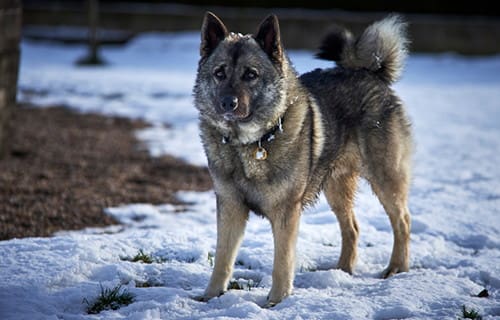
The Norwegian Elkhound

Feeding: 6 cups of dog food a day (1 cup is about 1 lb.)

Energy levelsHigh. A Norwegian Elkhound has very high energy levels that it spends most of its day upright; walking, or running around. Make sure you create some regular time to play fetch, or better yet, have two Elkhounds so they can spend the day playing together.

The Norwegian Elkhound’s hunting skills are unparalleled in the dog community in my opinion. They are like no other.  If you want to hunt something big and not just some ducks, your best bet of catching the big one is with a Norwegian Elkhound. 90% of all hunted elks in Norway are taken down with the assistance of a these dogs.

Though tenaciously brutal in the battlefield, these four legged beasts are the total opposite when it comes to home life. They usually get along well with other farm animals, and would never lift a paw to hurt any of them.

Their undying love and loyalty to you, “the owner”, causes it to handle anything that you love with the same utmost care and respect that you give it. The only downfall I have noticed about this type of breed, is that their loyalty is often attached primarily to the alpha of the human family.

norwegian elkhound in backyard

Best Dog Breed For Protection

If some kind of disaster will come, who can you trust to give you a heads up when SHTF?

You’re right: your watchdog.

This type of breed will protect you and try as best as possible to deter the danger away from you and your assets. The best example I can give you here is:


The German Shepherd

Feeding: 5-6 cups of dog food (1 cup is about 1 lb.)

Energy LevelsMedium to high. German Shepherds are high energy dogs who tend to act like medium energy dogs. They remain calm and relaxed when they are not working, but often display their high energy levels in the line of duty.

Have you ever wondered why the police choose German Shepherds to help them guard against criminals?

Because that is their specialty. Having had a German Shepherd called “Spotty,” I never had to worry about any fox or wolf ravaging through my livestock.

German Shepherds are very trainable, they are athletic and most of all they are a good family dog. They will do whatever it takes to protect you, your family, your farm animals, and assets as a whole.

best dog breeds for homesteaders

Best Dog Breed For Herding

Herd dogs, like watchdogs tend to be very trainable. They are usually very eager to please you, by learning your commands very quickly.

Any dog with the words “shepherd, cattle, or sheep” all probably fall into this category. This type of breed is characterized with having a lot of fur around the body. Why? I don’t know. Maybe to be able to stay all day into bad weather.

If your homestead has livestock, you must consider choosing this breed.

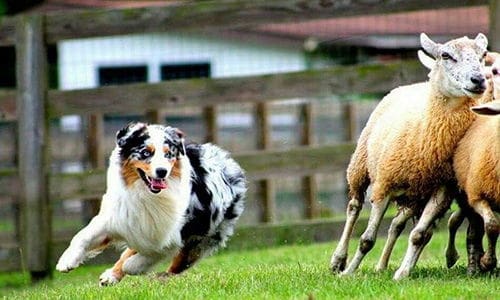
The Australian Shepherd

Feeding: 6 cups of dog food a day. (1 cup is about 1 lb.)

Energy levelsHigh. Australian Shepherds hate being in a confined area. They need space to run from one corner to another. They are often very eager to work, and if there isn’t any, they’ll often find one for themselves.

Australian Shepherds tend to have exuberant amounts of energy. They usually take the livestock to the pastures and back, in a much more orderly manner than a human could. They can easily fight off and scare away wild animals trying to prey on your livestock

Their stamina, strength and determination for a cause to listen and execute your instructions, make them an invaluable part of any homestead.

australian shepherd herding sheep


Best Dog Breed For Alerting

Alert dogs are often small, noisy, and have a very bad temper towards outsiders. They double down their alerting capabilities by being a great companion to the owner. Alert dogs are often allowed in the house as well as sleep in it in most cases. A good example I can give here is:

The Chihuahua

Feeding: 2-3 cups of dog food a day. (1 cup is about 1 lb.)

Energy levelsMedium. Chihuahuas are often calm throughout the day, until there is something out of the ordinary that happens. They really love to play and spend time with the human family

There is one trait that you get from a Chihuahua that you don’t get from any other type of dog breed, and that is: attention to detail. If anything happens that it is not used to, you will surely know by their noisy bark. This bark often alerts you, as well as the other bigger dogs to stand guard. Nothing goes unreported when the “dog dwarfs” are around.

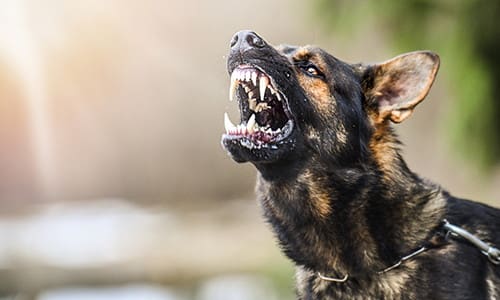
angry chihuahua

Even though I have phobias of dog breeds such as the Pit bull and Boer bull because of their reputation, I have learned from my best friend Bernie who happens to be a dog trainer that any dog can be trained to do anything, and that you should not have preconceived ideas.

A hunting dog for example, can be trained to be a protection dog, though it would be difficult, it is not impossible. True or not, my advice to you is this:

Do some extensive research on the breed that you want, coupled with using the formula I gave you at the beginning of this post, as well as asking other fellow homesteaders for recommendations. Then, surely you’ll make the right choice.